
To dissolve PAM powder reliably, disperse the particles before they form wet agglomerates. Add the powder at a controlled rate into moving water, then allow the selected grade to hydrate under suitable conditions. Increasing mixer speed after large lumps have formed is not a dependable substitute for correct initial wetting.
This guide explains how to dissolve PAM and investigate preparation problems. Product instructions and the preparation equipment procedure take priority over general rules about concentration, temperature or mixing time.


What a fish eye actually is
When several dry polymer particles enter water together, the outside can hydrate into a gel while the inside remains dry or incompletely hydrated. The resulting lump is often called a fish eye. Because water must penetrate the hydrated outer layer, the interior may take much longer to become usable.
Persistent fish eyes can make the effective solution concentration uncertain. They can also interfere with pumps or dosing lines. Therefore, preventing their formation is usually more practical than trying to repair a badly prepared batch.
Floating powder and bottom deposits may have different causes. For example, inadequate wetting can leave material at the surface, while dead zones can allow particles to accumulate below. Record what is observed rather than calling every preparation problem polymer degradation.
Establish the water and concentration first
Use preparation water that meets the selected grade’s recommendations. Check temperature, pH and relevant dissolved constituents if they may affect hydration or solution behavior. Contamination and oxidizing conditions deserve investigation, but a detectable trace constituent does not automatically prove significant damage.
Choose a concentration the equipment can disperse and transfer consistently. High-molecular-weight polymers can develop substantial viscosity at relatively low concentrations. Consequently, a stock that is too concentrated may circulate poorly even when the mixer is running.
For a mass-based preparation calculation, 0.2% supplied product by mass corresponds to 2 kg of product in a final solution mass of 1,000 kg. This is an arithmetic example, not a universal concentration recommendation. A percentage by mass should not silently be converted to grams per liter without considering the basis and density.
Add powder within the wetting capacity
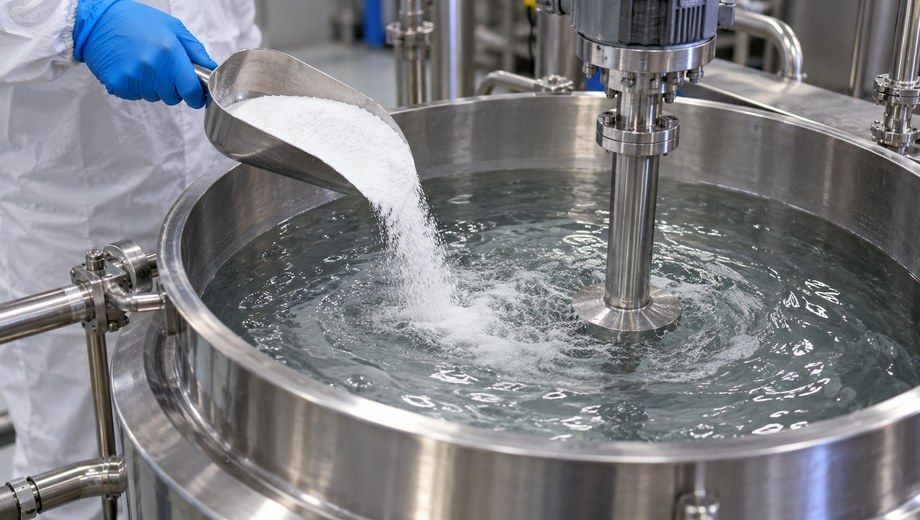
Start the mixing or circulation system before feeding dry PAM. Then introduce the powder gradually and distribute it so particles do not pile up in one place. Avoid pouring a bag rapidly into the tank or adding water onto a large bed of powder.
If visible agglomeration develops, reduce or pause the feed and inspect the wetting conditions. Meanwhile, check the powder feeder and actual water flow. A nominal concentration setting cannot compensate for a feeder that has lost calibration.
Automatic systems can improve repeatability, but they still need maintenance. ProMinent describes equipment for polymer wetting and maturation. The equipment example illustrates preparation stages; it does not prescribe settings for every PAM grade.
Separate initial dispersion from hydration
Initial wetting needs enough liquid movement to disperse the incoming particles. After dispersion, maintain the conditions needed for hydration without unnecessary mechanical stress. These stages do not necessarily require the same mixing intensity.
Rpm alone is insufficient for transferring a procedure between mixers. Impeller diameter, geometry and tank arrangement affect circulation and shear. Similarly, a deep vortex is not always beneficial because it can entrain air.
Hydration time varies with formulation, particle size, concentration, water chemistry and temperature. Use the supplier’s guidance and an approved reference preparation. Longer mixing is not automatically better, particularly if it prolongs unsuitable shear exposure.
Check preparation before routine dosing
Inspect for persistent gel lumps, floating masses and deposits. Verify that the solution transfers and doses consistently. In addition, compare the preparation record and treatment response with the approved reference.
Solution clarity is not a universal acceptance criterion. Some suitable preparations can appear hazy depending on formulation and water quality. Where viscosity is measured, hold concentration, temperature and measurement method consistent; otherwise, the numbers can be misleading.
| Observation | First checks |
| Fish-eye lumps | Powder feed rate, wetting and local accumulation |
| Floating powder | Feed point and surface circulation |
| Bottom deposits | Tank circulation and dead zones |
| Slow hydration | Grade instructions, concentration and preparation water |
| Unexpected treatment response | Preparation, dose basis, polymer selection and wastewater changes |
Decide whether a problematic batch can be used
Some incomplete hydration may improve with additional suitable time and circulation. However, a heavily agglomerated batch may remain unreliable. Evaluate it under the approved procedure before returning it to dosing.
Screening out lumps also removes some polymer. As a result, the remaining solution should not automatically be assumed to retain the original concentration. Reprocessing or disposal decisions should follow site requirements and supplier guidance.
Use a separate method for emulsion products
Emulsion PAM may require controlled dilution and inversion or activation. It does not follow the same wetting sequence as dry powder. Therefore, validate the preparation procedure when changing supplied form or formulation.
KolinSC supplies anionic, cationic, nonionic and amphoteric PAM grades. When requesting product information, include the intended duty, preparation system and difficulties observed so the discussion covers both treatment performance and preparation requirements.
Professional Water Treatment Chemical Supplier & One-Stop Industrial Solution Provider